It was a Tuesday afternoon in Kidwai Nagar when 43-year-old Rakesh Gupta walked into The Crown Multispeciality Dental Clinic with a swollen jaw swollen to twice its size. For six months, he had been faithfully applying clove oil and turmeric paste to a persistently throbbing molar — believing it was curing his infection. Instead, the X-ray told a brutal story: the infection had silently burrowed through the enamel, into the dentin, and deep into the pulp where bacteria were now breeding unchecked. What could have been a simple toothache treatment in Kanpur solved in one sitting had become a complex emergency requiring immediate root canal intervention — and the damage to the surrounding bone was already visible.
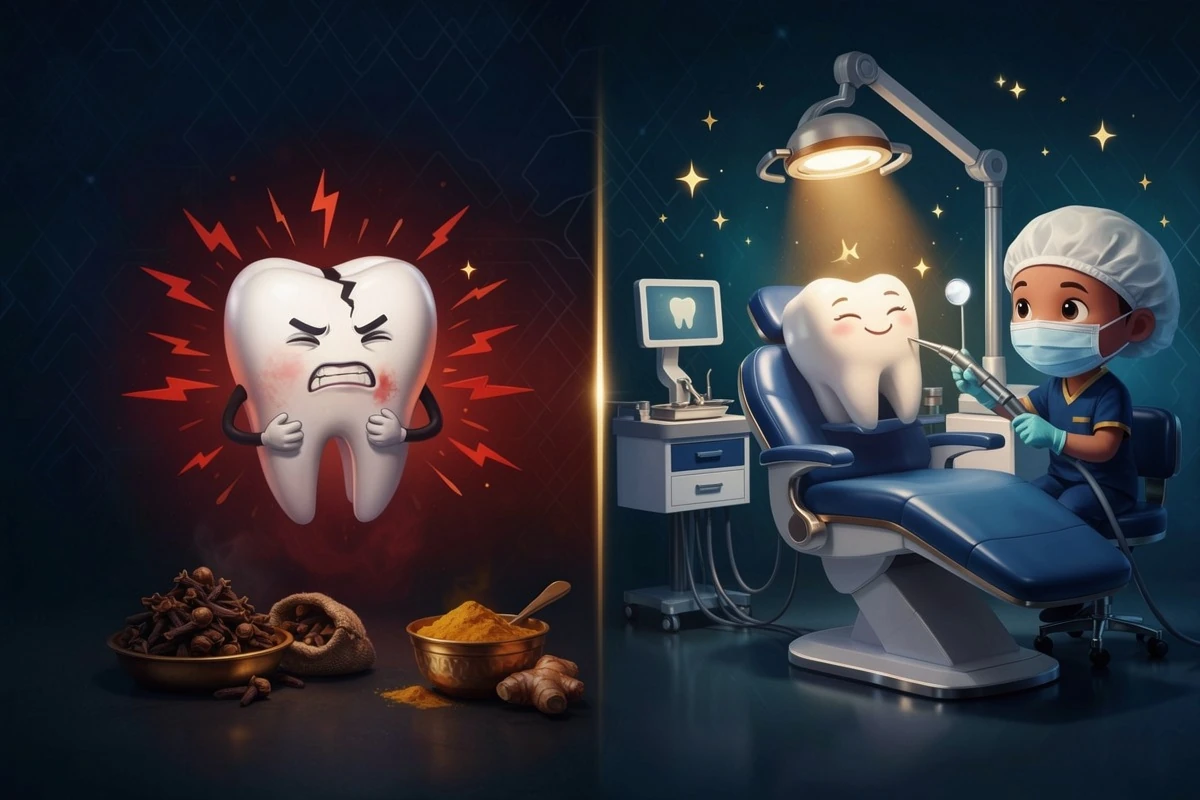
This is not a rare story. Across Kanpur, thousands of patients walk into dental clinics every month after weeks — sometimes months — of relying on dadi ke nuskhe: clove applications, haldi paste, salt water gargles, asafoetida, and hot oil compresses. While these remedies may provide temporary relief by numbing a nerve, they are doing nothing to treat the underlying infection. Worse, they are often masking the pain that is your body’s only alarm system.
Nuskhe vs Science — Dard Chhupana Ilaaj Nahi Hota
Let’s be absolutely clear about what’s happening when you put a clove on a throbbing tooth. Clove contains eugenol, a natural compound with local anesthetic properties. That means it literally numbs the pain receptors in your tooth. But here’s the problem — the anesthesia is superficial. The bacterial infection causing your pain is deep inside the pulp chamber, and no amount of clove on the outside will reach it.
The Real Timeline: What Nuskhe Actually Do vs. What They Claim
According to the Indian Dental Association’s public health messaging, hiding the symptom delays the diagnosis, and a delay of even 48 hours can be the difference between a simple filling, a root canal, or complete tooth loss. A study published in the Journal of Conservative Dentistry found that patients who self-medicated with home remedies for dental pain delayed seeking professional care by an average of 3.6 weeks — significantly worsening the clinical outcome.
5 Popular Kanpuriya Nuskhe That Are Doubling Your Dental Damage
Let’s examine the most commonly circulated home remedies in Kanpur households — and exactly how they damage your teeth:
-
1. Clove or Clove Oil Applied Directly on the Tooth
What it does: The eugenol in clove numbs pain receptors temporarily — giving a false sense of healing.
The damage: Concentrated clove oil can cause chemical burns and tissue necrosis on the gums and mucous membranes. When the pain returns after the numbing wears off, you apply more — further burning the surrounding tissue while the pulp infection rages beneath. A clinical review in International Endodontic Journal documented cases where repeated clove application caused periapical tissue necrosis. -
2. Haldi (Turmeric) + Water Paste Applied on Tooth & Gums
What it does: Turmeric has curcumin, an anti-inflammatory compound. Applied topically on the gum, it can mildly reduce surface inflammation.
The damage: It is completely ineffective against pulp infections deep inside the tooth. More critically, the thick yellow paste can get pushed into the cavity and seal in the infection, actually blocking drainage pathways. Patients often mistake reduced swelling for healing, while the infection expands silently into the bone. Additionally, turmeric stains teeth and gums permanently if left on for prolonged periods. -
3. Salt Water Gargles — Done Excessively & Aggressively
What it does: Warm salt water can reduce surface inflammation and rinse some debris from around the tooth.
The damage: Excessive, aggressive salt-water gargling can erode the natural protective coating of your oral mucosa. For patients with receding gums, hypertonic salt solutions can further irritate exposed root surfaces, accelerating sensitivity and gum recession. More dangerously, salt water does absolutely nothing against bacterial pulp infection — creating a dangerous delay while the infection deepens. -
4. Hing (Asafoetida) + Lemon Juice Paste
What it does: Believed to have mild antimicrobial properties when consumed, hing is often pasted directly on aching teeth.
The damage: Lemon juice is highly acidic (pH ~2), and its direct application on enamel causes dental erosion — dissolving the protective crystalline structure of your teeth within minutes. Repeated lemon-hing paste applications can strip enamel, creating new cavities and heightened sensitivity — on top of the original problem you were trying to fix. -
5. Hot Oil / Ghee & Heat Compress on the Cheek
What it does: Heat application on the outside cheek is believed to “draw out” the pain.
The damage: Applying heat to an already infected area increases local blood flow, which can accelerate the spread of infection. If an abscess is forming, heat can cause it to rupture internally, spreading bacteria through the bloodstream — a potentially life-threatening condition called sepsis. In multiple documented Indian hospital cases, patients heated clove oil directly and suffered severe facial burns and cellulitis.
Dard Ke Peeche Ka Asli Dushman — Pulp Infection Ka Sach
When home remedies fail (and they always eventually will), what you’re left facing is a pulp infection — the most common culprit behind persistent, throbbing toothache. The dental pulp is the living tissue at the center of your tooth containing nerves, blood vessels, and connective tissue. When bacteria from a deep cavity or crack reach this chamber, they multiply rapidly — often within days.
Stages of Pulp Infection — And What Each Stage Means
| Stage | What’s Happening | Symptoms | What’s Needed |
|---|---|---|---|
| Irreversible Pulpitis | Bacteria enter the pulp; inflammation becomes irreversible | Sharp pain on hot/cold, spontaneous throbbing | Emergency root canal within days |
| Pulp Necrosis | Nerves die; bacteria enter the root canal system | Pain may stop temporarily — this is a danger sign! | Root canal treatment urgently required |
| Apical Abscess | Infection spreads to the bone and forms pus pocket | Swelling, fever, pus drainage, visible facial puffiness | Emergency dental care immediately |
| Cellulitis / Sepsis | Bacteria enter bloodstream; potentially life-threatening | High fever, difficulty breathing/swallowing, severe swelling of face and neck | Hospital emergency, IV antibiotics, surgery |
Here’s the critical insight most patients miss: when the pain suddenly stops without treatment, it’s not because the tooth healed — it’s because the nerve has died. The bacteria have simply moved deeper. This is why so many patients at our dental clinic in Kanpur arrive with abscesses on teeth that “stopped hurting weeks ago.”
The 48-Hour Rule — When to Abandon Nuskhe and Run to a Doctor
At The Crown Dental Clinic, we give our patients a simple, memorable rule: 48 hours. If a toothache persists beyond 48 hours with any intensity — or if these accompanying signs appear even sooner — home remedies are officially dangerous, and professional toothache treatment in Kanpur is required immediately:
- ⚠️ Tooth pain lasting more than 2 days — This suggests the cavity has reached the pulp; only professional intervention can resolve it.
- ⚠️ Facial swelling, even mild — An abscess is forming. Heat and clove will only accelerate it.
- ⚠️ Fever or feeling generally unwell — The infection may be entering your bloodstream.
- ⚠️ Pain that wakes you up at night — Lying down increases pressure in the skull, and nocturnal pain is a classic sign of irreversible pulpitis.
- ⚠️ Bad taste in mouth or bad breath — Pus is draining internally, which almost always means the pulp is dead.
If you’re experiencing any of these signs, do not wait. Early intervention can save your natural tooth. Every day you delay, the infection consumes more of the bone that supports your tooth — potentially compromising not just one tooth but the adjacent ones as well.
“A toothache that can be cured with home remedies isn’t a toothache that needs to be cured. It’s a warning sign. The pain you feel with clove is the pain you’re ignoring — and every ignored warning leads to a bigger disaster.”
Pain-Free Modern Treatment — 100x Better Than Any Nuskha
Here’s what modern dentistry at The Crown’s Root Canal Centre actually looks like — and why it’s fundamentally different from anything grandma’s kitchen can offer:
Comparing Nuskhe vs. Modern Root Canal Treatment
| Aspect | Dadi Ke Nuskhe | Modern RCT at The Crown |
|---|---|---|
| Pain Level | Temporary numbing only; pain always returns | Completely painless with modern local anesthesia |
| Duration of Relief | 2-6 hours of numbing, then rebounding pain | Permanent — infection eliminated at the source |
| Effect on Infection | Zero — merely masks symptoms | Eliminates bacteria, seals root canal system |
| Technology | None | Digital X-rays (80% less radiation), rotary endodontics, apex locators, ultrasonic irrigation |
| Success Rate | 0% for pulp infections | Over 95% success rate with proper crown placement |
| Number of Visits | Unlimited — you keep using nuskhe forever | Typically 1-2 visits at The Crown |
At The Crown Dental Clinic, led by the husband-and-wife specialist duo of Dr. Apurva Chaturvedi (Maxillofacial Prosthodontist & Implantologist) and Dr. Priyanka Chaturvedi (Endodontist & Aesthetic Dentist), we use advanced rotary endodontics, digital apex locators, and 3D imaging to complete root canals in a single visit — often under 45 minutes — with zero pain and minimal discomfort.
The Cost of Delay: What Waiting 6 Months Actually Costs You
As this chart makes clear, the cost difference between catching a tooth problem early versus letting it fester with home remedies can be 14 times more expensive — not to mention the physical suffering, time lost, and emotional toll of losing a tooth that could have been saved.
Key Takeaways — What Every Kanpur Resident Needs to Remember
When you or a family member experiences tooth pain, here’s the bottom line:
- ✅ Clove numbs; it doesn’t heal. Eugenol is an anesthetic, not an antibiotic. The infection continues regardless.
- ✅ Pain stopping without treatment is the most dangerous sign. It means your nerve has died — the infection has entered deeper tissue.
- ✅ The 48-hour rule applies. Any toothache lasting beyond 2 days needs professional toothache treatment in Kanpur immediately.
- ✅ Early treatment saves money. A ₹2,500 filling early becomes ₹35,000 for an implant later.
- ✅ The Crown Dental Clinic offers same-day emergency toothache care. Located in Kidwai Nagar, Kanpur — specialist-led, pain-free, and appointment-ready.
Nuskhe Se Time Waste Mat Karo.
Kanpur’s specialist duo — Dr. Apurva Chaturvedi (MDS) and Dr. Priyanka Chaturvedi (MDS) — are ready to give you the pain-free, permanent solution you deserve. Same-day emergency appointments available.
Related Articles
Tooth Pain When Biting Down in Kanpur: 4 Common Causes
General Dentistry · 9 min read Tooth Hurts When You Bite Down: Four Common Causes Explained by Kanpur…
Cracked Tooth Repair in Kanpur: Save It or Remove It?
Restorative Dentistry · Kidwai Nagar, Kanpur Cracked Tooth Repair in Kanpur: How a Dentist Decides Between Saving a…
How Do Braces Work in Kanpur? The Biology of Tooth Movement
Orthodontics • 14 min read How Do Braces Work in Kanpur? The biology behind tooth movement — what…