Dental Implants • 9 min read
Dental Implants in Kanpur: What the Procedure Actually Involves
A patient-friendly walkthrough of planning, surgery, osseointegration, timelines and aftercare — written for people comparing dental implants in Kanpur with bridges and dentures.
If you have searched for dental implants in Kanpur, you have almost certainly noticed how little most clinics explain about the actual process. Marketing pages talk about “painless” and “same day,” but very few walk you through what happens between the first X-ray and the final crown. This guide does exactly that — from CBCT scanning and surgical guide design to the biological process of osseointegration and the six-month wait that surprises most first-timers. Whether you are booking a single tooth replacement or considering full-arch rehabilitation with All-on-4, knowing the sequence helps you ask better questions of any implantologist, including our own team at The Crown Multispeciality Dental Clinic & Implant Center in Kidwai Nagar.
What This Guide Covers (7 Chapters)
- Why Kanpur patients are choosing implants over bridges
- Who is a suitable candidate for a dental implant
- The implant procedure step by step at The Crown Dental Clinic
- Implant vs bridge vs denture: an honest comparison
- Osseointegration, healing timeline and aftercare
- Questions to ask your implantologist before you begin
- Book a consultation with our implant specialist in Kidwai Nagar
Chapter 1: Why Patients in Kanpur Are Choosing Implants Over Bridges
A conventional bridge is the traditional answer to a missing tooth: the neighbouring teeth are cut down and crowned, and a pontic hangs between them. It works, and for certain short-span cases it still works very well. But the biological cost is permanent. Supporting teeth lose healthy enamel and, for a single implant replacing one molar, roughly one in four traditional bridges requires at least one supporting tooth to be removed within ten years.
An implant avoids that trade-off entirely. It replaces the root, not just the crown. Because the titanium fixture is anchored in bone rather than bonded to adjacent teeth, chewing forces are transferred down into the jaw — exactly as they were with the natural tooth. That is why published survival data for implants looks the way it does.
Cumulative implant survival by years in function
Implant-level survival data pooled from long-term clinical studies (life-table analysis, 10,871 implants).
Source: Clinical Oral Implants Research, long-term analysis of 10,871 dental implants. A separate 2019 systematic review of 18 studies reported a 10-year implant-level survival of 96.4% (95% CI 95.2–97.5%).
There is a second, less discussed reason implants win in Kanpur specifically: alveolar bone preservation. After a tooth is lost, the jawbone in that socket begins to resorb within months — roughly 1 mm of width in the first year. A pontic in a bridge hides the gap but does nothing about the shrinking ridge beneath it. Over a decade that resorption can make later implant placement impossible without grafting. Placing the fixture into a fresh or preserved socket stimulates the bone to maintain itself.
Other practical reasons patients give us at consultation: no food trap under a bridge wing, easier flossing, the ability to eat a normal Indian diet without cutting everything soft, and the simple fact that an implant tooth can look and feel indistinguishable from a natural one when done well.
Chapter 2: Who Is a Suitable Candidate for a Dental Implant?
“Am I eligible?” is the most common first question, and the honest answer is: suitability is determined by three things — bone volume, soft-tissue health and systemic control. Age itself is not a barrier, because an implant only fuses with bone (it is never “rejected for age”). A 22-year-old and a 70-year-old with the same bone quality are equally good candidates, provided growth is complete.
Filter the list to see the criteria a Kanpur implant centre will assess before approving treatment.
The table above is a screening checklist, not a verdict. What actually decides the case is the three-dimensional scan. A CBCT CT scan measures height, width and density of bone at the proposed site, and the numbers are then matched against the implant’s own dimensions — an implant that is too long in dense anterior bone risks nerve injury, while too much width in the posterior mandible risks perforating the lingual cortical plate.
- ✓ Bone height and width — usually at least 6–7 mm of height and 2–3 mm of bone on either side of the fixture. Short clinical crowns (under 6 mm) suggest insufficient vertical bone.
- ✓ Controlled diabetes — uncontrolled diabetes measurably delays osseointegration and raises peri-implantitis risk. Well-controlled diabetes is usually acceptable; an HbA1c in the target range should be confirmed before surgery.
- ✓ Smoking and gutka/tobacco paan use — tobacco suppresses bone-forming cells and restricts blood supply. Heavy users should be counselled honestly; many specialists advise a cessation window before placement.
- ✓ Stable bite and adjacent teeth — heavy grinding changes both the loading plan and the restoration design. Untreated decay, failing root canals and active gum disease must be cleared before an implant is considered.
- ✓ Long-term commitment to maintenance — an implant is not maintenance-free. Annual reviews and interdental cleaning are non-negotiable, and peri-implant disease is the single commonest reason implants eventually fail.
Chapter 3: The Implant Procedure Step by Step
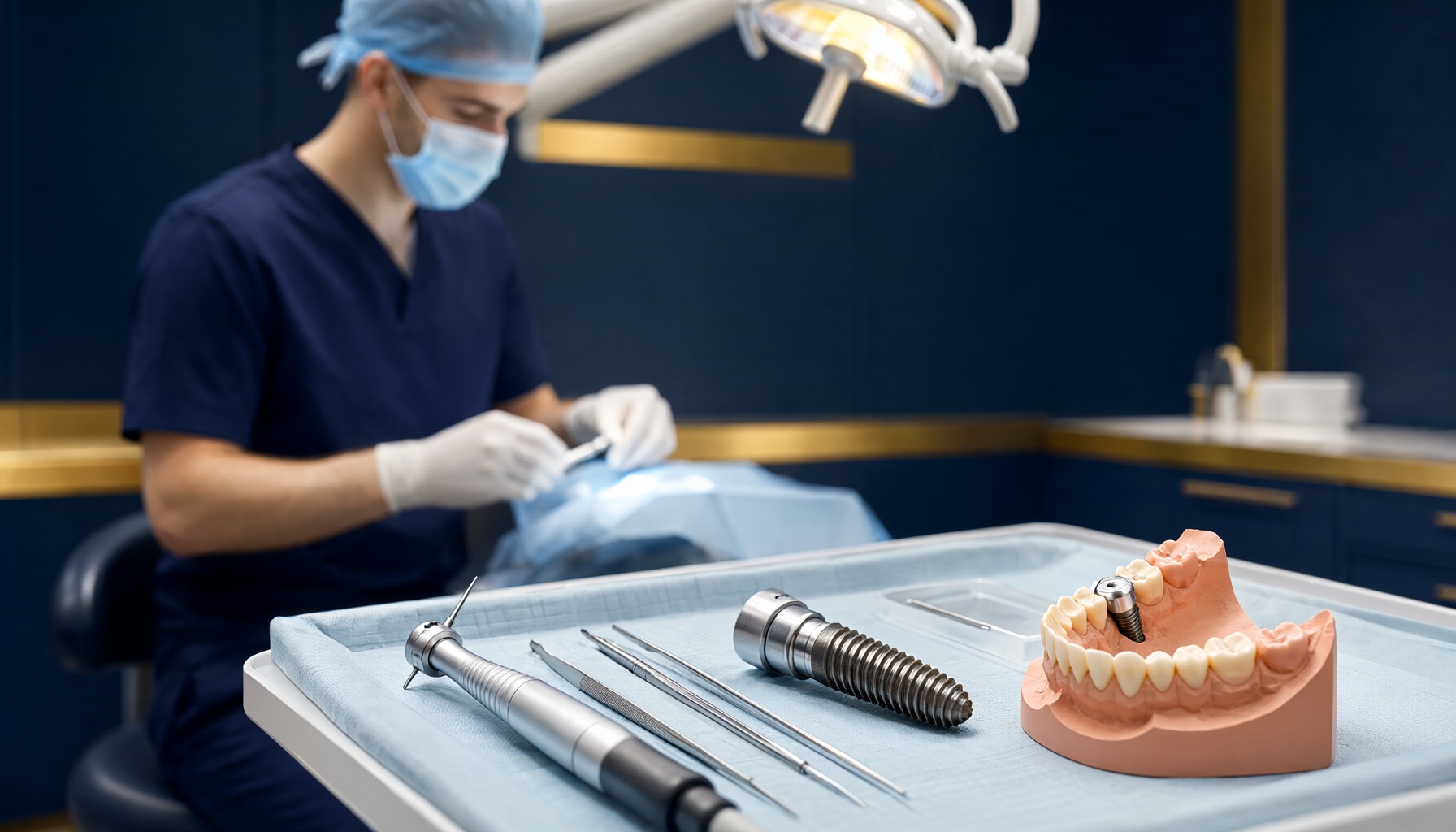
Here is exactly what happens when you walk in for dental implant treatment — the sequence our implantologist follows at our Kidwai Nagar centre.
Consultation, examination and intra-oral scan
Your medical and dental history, probing depths, gum condition and bite are recorded. A digital intra-oral scan replaces the old alginate impression trays, so the “impression appointment” is now a quick, gag-free scan.
CBCT 3D imaging
A limited-field cone-beam CT gives a true 3D map of the jaw. This is where nerve position, bone width, sinus floor height and any pathology become measurable — not guessable.
Digital treatment planning and surgical guide
The scan is loaded into implant-planning software. The implant is virtually positioned, then a 3D-printed surgical guide is fabricated so the drill follows the exact planned trajectory, angle and depth through the gum. This is what converts “an implant” into a predictable, prosthetically-driven result.
Grafting, if required
Where bone or soft tissue is deficient, a graft (guided bone regeneration, ridge augmentation, connective-tissue graft) is placed first and allowed to heal — commonly four to six months — before the implant itself goes in. Skipping this step is the root cause of most aesthetic compromises.
Surgical placement of the fixture
Under local anaesthesia, a small flap is raised (or a flapless keyhole is used where anatomy allows), the site is prepared with sequential, irrigation-cooled drills, and the titanium fixture is screwed in at planned depth and torque. A healing cap or cover screw closes the site. Most single-tooth placements take roughly 30–60 minutes of surgical time.
Osseointegration — the waiting phase
Nothing is attached yet. The implant is left alone while bone grows onto its surface. This phase is discussed in detail in Chapter 5.
Impression and abutment selection
The implant is opened, an impression or digital scan is taken, and the correct abutment (base) is selected or a custom titanium/zirconia base is milled for the case.
Trial of the tooth
A wax-up or mock-up is tried in your mouth so you can see and feel the planned tooth shape, shade, lip support and smile line before the final restoration is made.
Final crown delivery
The custom crown — monolithic zirconia, porcelain-metal or lithium disilicate depending on the load and the aesthetic zone — is bonded or screwed into place, contacts are checked, and occlusion is balanced. A surgical template can be used for the multi-unit case.
Review and maintenance schedule
A review at 2–4 weeks, then at around 3 months, 6 months and yearly thereafter, with hygiene instruction tailored to implants. This is the phase that protects your investment.
Typical time commitment by treatment type
Timelines vary with bone quality, grafting needs and the loading protocol chosen.
Chapter 4: Implant vs Bridge vs Denture: An Honest Comparison
No option is best for everyone. A 3-tooth span at the back of the mouth can often be handled predictably with a bridge. A single missing front tooth is almost always an implant case. Fully edentulous patients may prefer an immediate acrylic denture that they can reline as the ridge shrinks. Honest clinicians will sometimes recommend not to place an implant.
Side-by-side clinical characteristics
Scores are relative clinical comparisons (1 = lowest, 5 = highest) used to visualise trade-offs between the three replacement options.
“An implant is not a quick fix. It is a three-part engineering problem — surgery, biology and laboratory craft — and it is only as good as the least well-planned of those three.”
Chapter 5: Osseointegration, Healing Timeline and Aftercare
Osseointegration is the direct structural and functional connection between living bone and an implant surface. The term was coined by Per-Ingvar Brånemark in the 1960s, and it is the entire biological foundation of modern implantology. At the microscopic level, three overlapping phases occur:
Phase 1 — wound healing (0–7 days). Blood clot forms on the implant surface; platelets release growth factors; inflammatory cells clear debris. The soft-tile gum incision usually heals in about a week.
Phase 2 — bone formation (2–8 weeks). Osteoblasts lay woven bone directly on the implant, then that bone matures into lamellar bone. Roughened implant surfaces (acid-etched, sandblasted or hydrophilic-coated) dramatically speed this phase by anchoring bone cells within microscopic surface texture.
Phase 3 — maturation (3–6 months). The bone–implant interface remodels under load. Only after this does the implant reliably tolerate a functioning crown — which is why “immediate load” protocols carry more risk and are reserved for favourable cases.
Loading protocols: when the crown actually goes on
Protocol definitions follow ITI consensus terminology. Delayed loading remains the most conservative and is the default for most Kanpur cases.
So how long in real practice? In dense anterior bone with good primary stability, a straightforward single implant is often ready for its final crown at three months. In the posterior mandible — denser bone, higher chewing load — four to six months is the safer norm. Whenever grafting is involved, add four to six months before the implant is even placed. Patients planning treatment around a wedding, a job interview or an important function should ask for the latest possible date rather than the average.
Aftercare: what you actually control
Preventive care after implant placement
Peri-implant mucositis is among the most common post-implant findings; untreated, it progresses to peri-implantitis, the leading cause of late implant loss.
Chapter 6: Questions to Ask Your Implantologist Before You Begin
Choosing the best implant dentist in Kidwai Nagar, Kanpur should not rely on marketing claims alone. Ask these questions at your consultation — a confident specialist welcomes all of them.
Also confirm two practical points: who will actually place the implant (surgeon vs. prosthodontist vs. general dentist), and who is responsible for long-term follow-up. And always ask to see the CBCT and the digital plan — at a specialist centre these are shown to you on a screen, and any reputable implantologist is happy to walk you through them line by line.
Chapter 7: Book a Consultation with Our Implant Specialist
At The Crown Multispeciality Dental Clinic & Implant Center, Kidwai Nagar, Kanpur, implant treatment begins with a full clinical assessment and CBCT-based digital plan — not a sales conversation. You leave the first visit knowing whether you are a suitable candidate, how many implants your case needs, which loading protocol is appropriate, and a realistic timeline you can plan your life around.
We treat single-tooth cases, multiple implants, All-on-4 and All-on-6 full-arch rehabilitation, and complex cases involving bone grafting — under one roof, which matters when surgery, grafting, prosthetics and maintenance all have to be coordinated. If you have been searching for dental implants in Kanpur and want a second opinion on a case another clinic quoted, bring your existing scans with you.
Key Takeaways
1. An implant replaces the root, not just the crown. That is why it preserves bone and leaves neighbouring teeth untouched — the central advantage over a bridge for single and short-span cases.
2. Long-term data is reassuring. Implant-level survival runs about 96.4% at ten years and 94% at fifteen years, with most failures concentrated in the first year or linked to peri-implantitis.
3. Planning determines the result. CBCT imaging, digital planning and a 3D-printed surgical guide are what make placement accurate — and, when bone is short, grafting must come first.
4. The wait is biological, not administrative. Osseointegration takes three to six months because bone must physically grow onto the titanium. Faster protocols exist, but they are not appropriate for every case.
5. Maintenance decides longevity. Daily interdental cleaning, controlled sugar intake, no tobacco, and scheduled professional reviews are the difference between an implant that lasts thirty years and one that fails at seven.
Ready to Discuss Your Case?
Schedule a CBCT-based implant consultation at our Kidwai Nagar clinic in Kanpur. You will receive a written treatment plan and timeline — with no obligation to proceed.
Book Your Implant ConsultationRelated Articles
Tooth Pain When Biting Down in Kanpur: 4 Common Causes
General Dentistry · 9 min read Tooth Hurts When You Bite Down: Four Common Causes Explained by Kanpur…
Cracked Tooth Repair in Kanpur: Save It or Remove It?
Restorative Dentistry · Kidwai Nagar, Kanpur Cracked Tooth Repair in Kanpur: How a Dentist Decides Between Saving a…
How Do Braces Work in Kanpur? The Biology of Tooth Movement
Orthodontics • 14 min read How Do Braces Work in Kanpur? The biology behind tooth movement — what…