
Is Root Canal Treatment Painful in Kanpur? Five Myths Corrected With Clinical Reality
A straight, evidence-based look at what patients actually feel during and after endodontic treatment — and why most of the frightening stories in Kanpur’s waiting rooms belong to a previous era of dentistry.
Endodontics • 9 min read • Kidwai Nagar, Kanpur
If you have typed “is root canal treatment painful Kanpur” into a search bar, you already know how strong the fear is. It is the question patients in Kidwai Nagar, Gwaltoli, Halaipatti and across Kanpur ask most often — usually after a night of broken sleep, usually while holding a swollen cheek, and usually with a mental picture of a grinding drill passed straight through a live nerve. That picture is inherited, not observed. When we correct the root canal treatment myths in Kidwai Nagar that circulate in family groups and neighbourhood WhatsApp forwards, most patients are surprised to hear that a modern root canal is one of the more comfortable procedures in dentistry. This guide walks through five of the most persistent myths, explains what the clinical evidence and contemporary protocol actually say, and is honest about the one thing that does still hurt: the 24 to 48 hours after treatment.
Chapter 1 — Where the pain myth actually started
Root canal treatment has a genuinely deserved public reputation problem, but the fear is not new. It is inheritance. For most of the twentieth century, endodontics meant hand-driven steel files, no rubber dam, no operating microscope, and appointments spread across several sittings with a dying, infected pulp at the centre of the tooth. A 1970s-era root canal was genuinely unpleasant. The pain people remember — in family stories, in school anecdotes, in the bad memories of older relatives — belongs to that era.
Three historical facts explain almost everything. First, pulpitis in the past was frequently managed by devitalising pastes containing paraformaldehyde; the tissue did not simply go numb, it was chemically destroyed, and the aftermath could be violent. Second, rotary instrumentation did not exist before the late 1980s, so shaping a curved molar canal with stiff stainless steel files meant repeated appointments and considerable time pressure. Third, isolation with a rubber dam — the single most important barrier against bacteria re-entering the cleaned canal — was not a routine standard. Each of these limits has been removed.
There is also a second, subtler source of the myth: confusing the cause with the cure. The pain patients associate with a root canal is almost never produced by the root canal. It is produced by the infected, pressurised pulp and by inflammation spreading into the surrounding bone — a condition dentists call apical periodontitis. Root canal treatment is the procedure that ends that pain source by removing the infected tissue and disinfecting the canal system. Asking whether root canal treatment is painful is, in a real sense, like asking whether draining an infected abscess hurts. Yes, the procedure is not entirely free of sensation. But the untreated alternative is not comfort — it is progressive swelling, possible systemic infection, and often emergency attendance at night.
Every point below is written for the patient sitting in the chair with a genuine question, not for a textbook. Where figures are given, they represent commonly reported ranges in endodontic literature and clinical practice, not a promise about an individual tooth. Your own diagnosis always comes from an examination and an X-ray in person.
Myth One: “Root canals are extremely painful” — what anaesthesia and rotary files really do
The myth: the nerve is being cut out, so the nerve must be screaming the whole time.
The clinical reality: root canal treatment is performed under local anaesthesia, and the anatomy works in the dentist’s favour. The tissues that hurt are the vital pulp inside the chamber and the apical tissues at the root tip. The professional anaesthetic is placed in the mandibular or maxillary bone — outside the tooth — blocking the nerve before it reaches the pulp. Once that block is effective, removing the pulp produces essentially no pain at all, because the nerve is already unable to transmit the signal.
Contemporary practice closes the remaining gaps that once made anaesthesia unreliable. Where a tooth is severely inflamed, pulpal anaesthesia can be incomplete; dentists can then supplement with intraligamentary (periodontal ligament) injections, intraosseous injections, or a second buccal and palatal infiltration. For anxious patients, nitrous oxide inhalation or oral sedation removes the anticipatory fear component entirely — and in many cases the anticipatory fear, not the procedure itself, was the dominant source of distress. A rubber dam keeps the field dry and, usefully, physically blocks saliva and prevents the patient from tasting and fearing the experience.
The instruments have changed just as dramatically. Rotary nickel-titanium (NiTi) files are manufactured from a super-flexible alloy that follows the natural curve of a canal far more predictably than hand files. They cut continuously at a controlled speed, remove debris effectively, and dramatically reduce working time and the number of appointments. Because they are smaller and more accurate, they also allow a minimally invasive access cavity — less healthy tooth removed, faster recovery. Under an operating microscope, which our endodontic practice uses for complex cases, canals that were historically missed entirely (such as the second canal of the upper first molar) can be located and cleaned, which is the single biggest reason for long-term success.
Reported discomfort during common dental procedures
Illustrative comparison of patient-reported discomfort scores (0 = none, 10 = worst imaginable) commonly discussed in endodontic practice settings.
A root canal performed with effective local anaesthesia sits in the same comfort band as a routine filling. Surgical extraction and impacted third-molar removal sit noticeably higher — which is precisely why “just remove it” is not automatically the gentler path.
Honest caveat: patients with severe apical abscesses, acute swelling, or a tooth that has already been opened and drained elsewhere may still feel tenderness. In those situations a good endodontist will say so, may stage treatment, and will plan pain control in advance. Being truthful about this is far more valuable than a blanket promise of zero discomfort.
Myth Two: “Pulling the tooth out is always the easier choice”
The myth: extraction is a quick, clean, final solution, while a root canal is a complicated procedure you will have to keep revisiting.
The clinical reality: extraction is fast. What it is not is conservative — and the consequences of losing a tooth cascade well beyond the gap itself. Removing a natural molar changes the bite immediately; opposing teeth begin to over-erupt within months, neighbouring teeth tilt into the space, and the joint that governs that tooth starts to compensate. Restoring the lost unit with a bridge or an implant requires more appointments, more intervention and, in the case of an implant, a surgical procedure with its own healing timeline. Root canal treatment followed by a crown, by contrast, returns a full-strength natural tooth that behaves exactly as it did before.
Bone is the other hidden cost of extraction, and it is irreversible. Once a tooth is removed, the alveolar ridge beneath it begins to resorb immediately. Reabsorbed bone means a future implant may require grafting, and grafting means a longer, more involved procedure. Preserving the tooth preserves the bone that holds it. It is for precisely this reason that contemporary restorative guidance consistently frames natural tooth preservation as the first option and extraction as the alternative — not the shortcut.
A genuine exception exists, and a responsible dentist will raise it: a tooth with a vertical root fracture, a tooth whose root is too short or too curved to be cleaned predictably, or a wisdom tooth with pathology that makes endodontic therapy futile. In those cases extraction — and often a replacement plan — is the correct clinical decision. The point of this chapter is not that extraction is always wrong. The point is that it is rarely the automatic answer, and patients deserve a genuine diagnosis before either path is chosen.
Preserving the tooth vs. removing it
Myth Three: “A root-canal tooth always needs a crown immediately”
The myth: the moment treatment ends, a crown goes on. No exceptions.
The clinical reality: the need for a crown after endodontic treatment depends almost entirely on how much healthy tooth structure remains once the decay, old filling and access cavity are accounted for. A front incisor treated for a small lesion, with intact labial and lingual walls and strong cusp support, may need only a bonded restoration. A lower molar with a large existing filling, undermined cusps and a wide access preparation is a completely different case — here a cuspal-coverage crown is genuinely protective, because the remaining enamel is unsupported and prone to fracture.
The biology behind the myth is real even if the rule is too absolute. Root canal treatment removes the pulp, and the pulp supplies moisture to the dentine. As the tooth dries out, dentine becomes more brittle, and unsupported cusps under heavy chewing force can crack. A properly designed crown does not just “protect the tooth” — it re-establishes a continuous sealed coronal structure that prevents leakage, and a sealed canal system is exactly what determines long-term success.
Timing matters just as much as necessity. Placing the definitive restoration too soon, before the tooth has settled and before post-operative symptoms have resolved, risks building a heavy, high contact on a tender tooth. Many endodontists recommend a short observation period first, then the definitive restoration. Ask your dentist directly: how much sound tooth is left, and does this tooth genuinely need cuspal coverage? A good answer will reference the amount of remaining structure, not a fixed rule.
Myth Four: “It takes weeks and a string of appointments”
The myth: you will be in and out of the clinic five or six times over a month, lying on your side in between.
The clinical reality: single-visit root canal treatment is now a well-established protocol for appropriately selected cases. Rotary NiTi instrumentation, continuous irrigation with activated sodium hypochlorite, careful drying with paper points and a well-sealed temporary or immediate definitive restoration allow a qualified endodontist to complete the entire canal system in a single appointment for a straightforward case. Published comparisons between single-visit and multiple-visit protocols report broadly comparable healing outcomes when case selection, asepsis and obturation quality are controlled.
That said, multiple visits still exist — and knowing when is a mark of good clinical judgement rather than an inconvenience. A staged approach is appropriate when there is active swelling and exudate that needs to settle, when a calcium hydroxide dressing is required to address persistent infection, when a fracture or a complex anatomy needs further assessment, or when canal negotiation is difficult and forcing a single-visit endpoint would compromise quality. Two visits, well executed, beat one rushed visit that fails.
Appointment patterns under a modern rotary protocol
Illustrative distribution of appointments required across a general endodontic caseload managed with rotary NiTi instrumentation and rubber dam isolation.
The majority of cases are completed in a single appointment. Staged treatment remains reserved for infection control, exudate, complex anatomy or fractured teeth.
The real time commitment to plan for is not the chair time — it is the waiting while the tooth settles. Most practices complete the technical work in roughly 60 to 90 minutes per tooth, and the schedule impact on a working day is usually modest.
Myth Five: “A root-canal tooth is doomed”
The myth: once a tooth has had a root canal it is temporary at best, and it will certainly fall out eventually.
The clinical reality: the most common reason a root-canal tooth fails later is not the root canal itself — it is bacterial re-entry. Endodontically treated teeth are structurally different from untreated teeth: they are more brittle and more prone to fracture, they often carry a large restoration, and many are posterior teeth that take heavy chewing loads. If the final restoration is poorly adapted, or if a new decay forms at the crown margin, or if the tooth is not protected by cuspal coverage, bacteria can re-enter the cleaned canal and reinfection occurs. The data consistently point to restoration quality as one of the strongest predictors of endodontic success — which is why your dentist’s talk about the crown is really a talk about the long-term survival of your tooth.
What actually determines whether a root-canal tooth survives
Three aftercare habits do more for longevity than anything done in the chair. First, treat the treated tooth as a priority tooth: floss around it daily, and change that side of the brushing routine to a soft brush aimed at the gum margin. Second, avoid using a root-canal tooth to crack open packets, bite nuts or hold objects — the single most common cause of catastrophic fracture in endodontically treated molars. Third, keep up with routine check-ups, because a small lesion caught early is infinitely easier to manage than a large one. And if you notice a new bite that feels early, a dark margin, or tenderness on biting, do not wait — that is exactly the window in which re-treatment or a revision is still simple.
There is also a fair point about risk that deserves acknowledgement: even well-executed root canals occasionally fail, because some canals are anatomically extraordinary, some teeth are cracked beyond detection, and no biological procedure offers guarantees. What has genuinely changed is the option set. A failed root canal today may be managed with non-surgical retreatment, or with a small surgical procedure to address a stubborn lesion. Those options simply did not exist in the era that created the myth.
Chapter 7 — The real source of post-treatment discomfort, and how to manage it
If the procedure itself is comfortable, what is the soreness everyone complains about? Understanding this single point removes most of the remaining anxiety. When a dentist instruments and irrigates an inflamed canal, the chemical and mechanical irritation inevitably produces a brief inflammatory flare in the surrounding periodontal ligament and bone — the same tissue that produced your original biting pain. It is a healing response, not a sign of damage. Typically it rises over the first day, peaks around 24 to 48 hours, and settles as the tissues calm down.
Typical post-treatment tenderness trajectory
Illustrative pattern of reported tenderness in the days following well-executed root canal treatment.
Tenderness follows a predictable curve. Knowing the curve in advance is the difference between reassurance and panic on day two.
- Stick to soft, cool food for 24–48 hours. Avoid biting directly on the treated tooth, and avoid very hard or very hot items while it is tender.
- Use anti-inflammatory pain relief as prescribed. Ibuprofen-based analgesia combined with paracetamol is the standard first-line approach for post-endodontic pain; anti-inflammatories address the cause rather than masking it. Follow your dentist’s instruction on dosing.
- Warm salt-water rinses after the first day. Gentle rinsing helps keep the area clean; vigorous rinsing in the first 24 hours can disturb the clot at the access site.
- Antibiotics are not routinely indicated. They are reserved for systemic involvement — fever, spreading swelling, malaise — and should never be self-started. Ask whether you genuinely need them.
- Know when to call back. Pain that is increasing after day three, swelling that grows, a bad taste, or a high bite that does not settle all warrant a prompt review. Most need only a short adjustment, but they should be seen.
One final point on anxiety, because it deserves its own weight in this discussion. Dental fear is a recognised clinical condition, not a character flaw. Patients who disclose fear before treatment consistently report a better experience, because the plan can be adapted — staged appointments, nitrous oxide, premedication, a stop signal, or simply a longer first visit. The root canal treatment myths in Kidwai Nagar that cause the most harm are the ones that keep people in pain for six months because they were afraid to walk in. That delay, not the treatment, is what creates the emergencies.
“The patients who tell me a root canal was the worst thing they have experienced are almost always describing a tooth that was severely infected when they arrived — not the procedure. Remove the infection, and the pain leaves with it.”
Dr. (Mrs.) Priyanka Chaturvedi — MDS, Endodontics & Aesthetic Dentistry
Myth versus reality: the five-myth summary
If you search for “is root canal treatment painful Kanpur” and read nothing else, read this table. It condenses the clinical position on each of the myths examined above.
Questions worth asking before you decide
Settling the doubt rarely needs a guarantee. It needs information. Before leaving any Kanpur practice with a treatment plan, ask these five questions:
- Is this tooth restorable, and what proportion of healthy tooth structure will remain?
- Why does this tooth need a root canal specifically — what is the diagnosis on the X-ray?
- Will you use rubber dam isolation, and will the treatment be completed in one visit or staged?
- Do I actually need a crown, and if so, when will it be placed?
- What post-treatment discomfort should I expect, and what is the number I should call if it worsens?
Still Not Sure? Ask Before You Decide.
The best consultation is one where nothing is decided in the first ten minutes. Book an assessment at our Kanpur clinic, have the tooth properly assessed on X-ray, and leave with a clear explanation of what the pain myth hides — and what the honest risks actually are. Bring your questions from this article; we will answer every one of them before any treatment decision is taken.
Book a ConsultationPrefer to talk first? Call +91 87075 04822 — same-day emergency appointments are available.
Key takeaways
The question is root canal treatment painful in Kanpur has a consistent clinical answer: under effective local anaesthesia, with rubber dam isolation and rotary NiTi instrumentation, the procedure itself is comfortably tolerated by the large majority of patients — far more comfortably than the surgical alternative many assume is easier. What patients remember as root canal pain is almost always the pre-treatment infection and the inflammation that follows instrumentation, not the act of cleaning the canal.
Extraction is not the effortless answer. It is fast, but it costs bone, alters the bite, and creates a replacement problem that usually needs more intervention than the root canal ever did. A crown is not automatic — it depends on remaining structure, and the timing should be decided deliberately. A single appointment is now the norm for selected cases, with multiple visits reserved for genuine clinical reasons. And a root-canal tooth is not doomed: long-term survival depends far more on the quality of the final restoration and on disciplined aftercare than on any myth about the procedure itself.
The shortest possible summary: a modern root canal relieves pain, protects a tooth that cannot be replaced identically, and is uncomfortable only for a brief, predictable window that is straightforward to manage. The real risk in this decision is not the treatment — it is the delay.
Related Articles
Root Canal Centre in Kanpur • Treatment Overview • Emergency Dentistry • More RCT Articles
Why Do Teeth Shift With Age? Common Causes Explained
Teeth can move gradually in adulthood due to normal bite forces, changes after tooth loss or orthodontic treatment,…
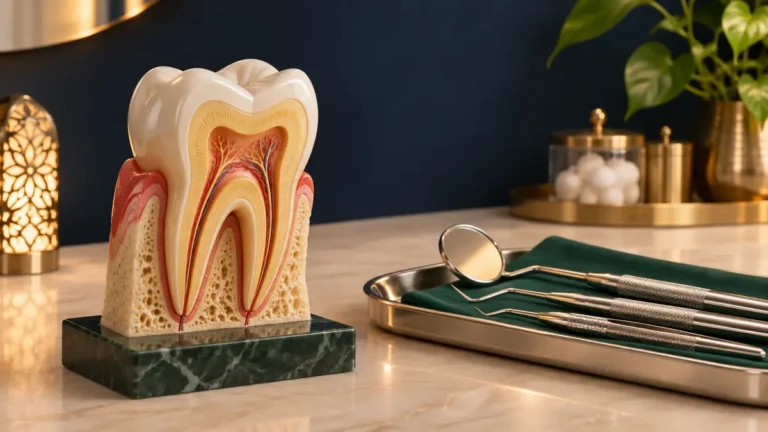
Root Canal Treatment: What Happens During Care and Recovery
Learn why root canal treatment may be recommended, what happens during the procedure, what recovery can feel like,…

Toothache Gets Worse When You Lie Down? Causes and Next Steps
Toothache that worsens when lying down may relate to decay, pulp inflammation, a crack or infection. Learn safe…