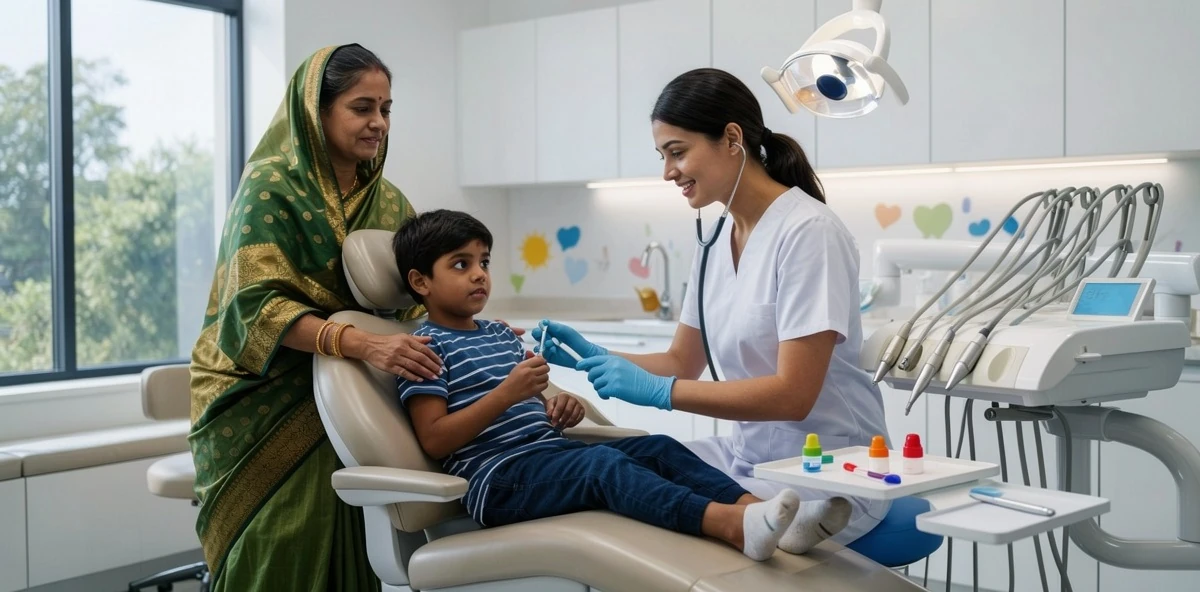
It starts innocently. A school dental check-up notice comes home in your child’s bag. You think, “Good, free check-up.” But what happens next is something thousands of Kanpur parents know all too well: your child comes home crying, terrified, refusing to ever go back to a dentist. The word “dentist” becomes a trigger. And just like that, a lifetime of dental anxiety begins.
Finding a compassionate pediatric dentist in Kanpur isn’t just about fixing cavities — it’s about breaking the cycle of fear before it hardens into adulthood avoidance. In this guide, we’ll unpack why children are terrified, what the research says about dental anxiety in India, the sugar trap unique to Uttar Pradesh, and exactly how The Crown Dental Clinic is changing the narrative for child dental care in Kanpur.
The Kanpur School Dental Check-Up Horror Story
Picture this: A government-organized or school-mandated dental camp arrives at your child’s school. A temporary setup is arranged in a classroom or hallway. Dozens of children are lined up. The dentist — well-meaning but rushed — examines each child in under two minutes. There’s no rapport, no explanation, no warmth. The chair is unfamiliar. The instruments look scary. Other children are crying ahead in the queue. By the time it’s your child’s turn, they’re already shaking.
This scenario plays out across Kanpur schools every year. A study published in the Journal of the Indian Society of Pedodontics and Preventive Dentistry found that the prevalence of dental anxiety in 6–12-year-old children in Southern India was a staggering 84.4%, while even in North Indian children aged 5–10 years, measurable dental fear was present in a significant subset of the population. Another landmark study of 400 children found that 61.5% had severe dental anxiety, 23% had mild anxiety, and only 17% had no anxiety at all.
The problem isn’t the dental check-up itself. It’s the context. School camps lack the three critical elements pediatric dentistry demands: time, environment, and trust. When a child’s first encounter with a dentist happens in a rushed, impersonal school camp, the brain creates a powerful negative association. And that association can last a lifetime.
Dental Anxiety Levels in Indian Children (Study of 400 Children, Ages 6–12)
Source: PubMed/PMC studies on pediatric dental anxiety in India
Why Your Child’s First Dental Visit Matters More Than You Think
The American Academy of Pediatric Dentistry (AAPD) recommends that a child’s first dental visit should occur by their first birthday or within six months of the first tooth erupting. In Kanpur, most parents don’t even consider a dentist visit until there’s visible decay or pain — often by age 4 or 5. By then, the first experience is already associated with discomfort and invasive treatment.
Here’s what the research tells us: children who have a positive first dental visit — one that’s preventive, gentle, and playful — are far more likely to maintain regular dental check-ups throughout adulthood. Conversely, children whose first visit is for pain or emergency treatment develop what researchers call “dental fear and anxiety” (DFA), which leads to avoidance behavior, worsening oral health, and a vicious cycle of neglect.
A PMC-published study confirmed that dental fear in children is not only associated with fear of pain or invasive procedures, but also with separation from parents and confronting unfamiliar people or environments. This means the solution isn’t just “better dentistry” — it’s better environment design, better communication, and a fundamentally different approach to the child’s emotional state.
Chocolate, Churan & Mithai — The UP Sugar Trap
Let’s address the elephant in the room — or rather, the mithai on the table. Uttar Pradesh has a deep, cultural relationship with sweets. From the daily churan packets that kids love (which are essentially sugar and spice compressed into candy), to the endless stream of peda, barfi, and jalebi at every celebration, sugar is woven into childhood in Kanpur in ways parents often don’t even register.
A cross-sectional study on parental knowledge and practices in India found that 66% of children consumed sweets daily, and 33.3% drank sweetened beverages daily. Only 68% brushed their teeth twice a day. A meta-analysis reported a 49% prevalence of dental caries among Indian children. The WHO has been clear: children under 2 years of age should not consume any free sugar at all. Yet in Kanpur, it’s common to see toddlers being fed rusk dipped in sweetened milk or given churan as a “digestive” treat.
The rising consumption of sugar-sweetened beverages (SSBs) and ultra-processed foods in India has been described by researchers as an intensifying burden on oral and systemic health. In Kanpur specifically, the combination of traditional sweets + modern packaged snacks + low awareness of oral hygiene creates a perfect storm for early childhood caries (ECC).
Indian Children: Daily Oral Habits vs Sugar Consumption
Source: PMC Cross-Sectional Study on Parental Knowledge & Practices (2025)
Did you know? The bacteria Streptococcus mutans, which causes cavities, feeds on sugar and produces acid that dissolves tooth enamel within 20 minutes of sugar consumption. Every time your child eats a piece of chocolate or a spoonful of churan, a 20-minute acid attack begins on their teeth. Multiple snacks a day means the teeth never get a break to remineralize.
5 Signs Your Child Needs a Dentist RIGHT NOW
Many Kanpur parents wait until a child is in visible pain before seeking dental help. By then, what could have been a simple preventive visit has become a complex, expensive, and fear-inducing treatment. Here are five signs you should never ignore:
- 1. White or brown spots on teeth. These are early signs of demineralization — the precursor to cavities. Catching them now means simple fluoride treatment. Waiting means drilling and filling.
- 2. Complaints of pain while eating hot, cold, or sweet foods. This indicates enamel damage or an approaching cavity. Sensitivity is the tooth’s early warning system.
- 3. Persistent bad breath. While it can be dietary, chronic halitosis in children often signals gum inflammation, trapped food, or early decay that brushing alone can’t fix.
- 4. Visible holes or dark patches. A cavity has already formed. The longer you wait, the deeper it goes — from enamel to dentin to the nerve. Each layer means more pain and more invasive treatment.
- 5. Bleeding gums while brushing. This isn’t “normal” — it’s gingivitis. In children, it’s usually caused by plaque buildup and poor technique. A professional cleaning and education session can reverse it completely.
How The Crown Makes Kids Smile Instead of Scream
At The Crown Multispeciality Dental Clinic & Implant Center, we’ve completely reimagined what a child’s dental visit looks like. The difference isn’t just in the dentistry — it’s in the psychology. Here’s our approach to child dental care in Kanpur:
Child-Friendly Environment
Bright colors, cartoon-themed walls, a play area in the waiting room, and dental chairs that don’t look intimidating. The environment signals “safe” before the child even sits down.
Tell-Show-Do Technique
We explain every instrument in child-friendly language (“this is Mr. Thirsty, he drinks water from your teeth”), demonstrate it, and only then proceed. No surprises, no fear of the unknown.
Parent Involvement
Research confirms that parental presence reduces separation anxiety. Parents are welcome in the treatment room, holding their child’s hand throughout the procedure.
Positive Reinforcement
Every visit ends with praise, a sticker, and a small reward. The brain associates “dentist” with “achievement” instead of “pain.” This is behavioral conditioning that works.
For children with severe anxiety, we also offer painless and sedation dentistry options — ensuring that even the most frightened child can receive necessary treatment without trauma. The goal is never to force a child through a frightening experience. The goal is to make the experience not frightening in the first place.
“A child who cries at the dentist at age 5 becomes an adult who avoids the dentist at age 35. The fear doesn’t go away — it just goes silent. Breaking the cycle starts with the very first visit.”
The Sunday Appointment Hack for Working Kanpur Parents
One of the most common reasons Kanpur parents delay dental visits for their children is simple: they can’t take time off work. School hours overlap with clinic hours. Weekday appointments mean losing a day’s wage or taking leave. The result? Preventive visits get postponed indefinitely, and the first visit ends up being an emergency.
At The Crown Dental Clinic, we understand this reality. That’s why we offer Sunday appointments specifically for pediatric dental care. Sundays work because: (1) both parents can be present, which research shows reduces child anxiety significantly; (2) the child isn’t missing school or exhausted after a full day; (3) the parent can dedicate the entire day to their child’s comfort without work stress; and (4) the clinic is calmer and less crowded, meaning more personalized attention.
Here’s the hack: book the first appointment on a Sunday morning, when your child is well-rested and fed. Make it a “dental day” — follow it up with a trip to the park or their favorite meal. The brain associates the dental visit with a positive day overall, not just the clinic experience.
What Other Kanpur Parents Are Saying
Don’t just take our word for it. Here’s what Kanpur families have experienced after switching to a child-centered dental approach at The Crown:
“My 6-year-old son used to scream just hearing the word ‘dentist.’ After his first visit at The Crown, he actually asked when he could go back. The team explained everything to him like a story. He got a sticker and felt like a hero. I couldn’t believe it.”
— Priya S., Swaroop Nagar, Kanpur
“The Sunday appointment was a game-changer for us. Both my husband and I work, and we could never manage weekday visits. They caught early cavities in my daughter’s molars that would have become serious. Now she goes every 6 months without any fear.”
— Anita R., Kalyanpur, Kanpur
“After the school dental camp, my son was so scared he wouldn’t even open his mouth. The Crown team used the tell-show-do method and let him hold the instruments first. He sat through the entire cleaning without a single tear. As a parent, that was everything.”
— Mohammad K., Kidwai Nagar, Kanpur
Key Takeaways
Dental fear in children isn’t inevitable — it’s preventable. The research is clear: early, positive, well-designed dental visits create lifelong oral health habits. Waiting until there’s pain guarantees trauma. Choosing the right pediatric dentist in Kanpur — one who understands child psychology, uses proven behavior management techniques, and creates a genuinely welcoming environment — is the single most important decision you can make for your child’s dental future.
Remember: every cavity prevented today is a filling avoided tomorrow. Every positive visit today is a fear-free adult tomorrow. The sugar trap of UP culture is real, but so is the solution — consistent, compassionate, preventive dental care starting early and continuing every six months.
Ready to Give Your Child a Fear-Free Dental Experience?
Book a Sunday appointment with our pediatric dental team today. Your child’s first visit should be a happy memory — not a horror story. Let’s build a lifetime of healthy smiles together.
Book Your Child’s AppointmentRelated Articles

Teeth Whitening in Kanpur: 1-Hour Bridal Smile Before D-Day
Cosmetic & Aesthetic Dentistry • 8 min read Teeth Whitening in Kanpur: The 1-Hour Bridal Smile Before D-Day…
Wisdom Tooth Removal in Kanpur: Cost, Pain & 24-Hour Warning
Oral Surgery • 9 min read Wisdom Tooth Removal in Kanpur: Cost, Pain & the 24-Hour Warning The…
Pediatric Dentist in Kanpur: Why Gumti Nagar Parents Trust The Crown
Pediatric Dentistry • 8 min read Baccha Daant Dard Se Ro Raha Hai? Why Gumti Nagar Parents Trust…