
Imagine this: you’ve just completed your root canal treatment — the painful swelling, the sleepless nights, the multiple sittings. The infection is gone, the pain has vanished, and your dentist hands you a bill with one more line item: a dental crown after root canal. You hesitate. “₹3,000 to ₹9,000 for a cap? That’s expensive. I’ll manage without it.” Three months later, you’re biting into a crispy samosa at your favourite Swaroop Nagar stall and hear a sickening crunch. Not the samosa. Your tooth. It has split vertically, straight down to the root. This article explains exactly why this happens, what skipping a crown after root canal actually costs you over time in Kanpur, and what your real options are.
1. The Rakesh’s Story: A Cautionary Tale from Swaroop Nagar
Mr. Rakesh, a 45-year-old business owner from Swaroop Nagar, walked into our clinic in Kidwai Nagar with a dental disaster on a Tuesday morning. Six months earlier, he had completed a root canal on his lower left molar at a clinic near Mall Road. The dentist had clearly told him: “Sir, next step is a crown. Without it, this tooth will break.” Rakesh checked the price — approximately ₹4,000 for a metal crown or ₹7,000 for zirconia — and decided to defer. “I’ll get it done after Diwali,” he told himself. “The tooth isn’t hurting anymore.”
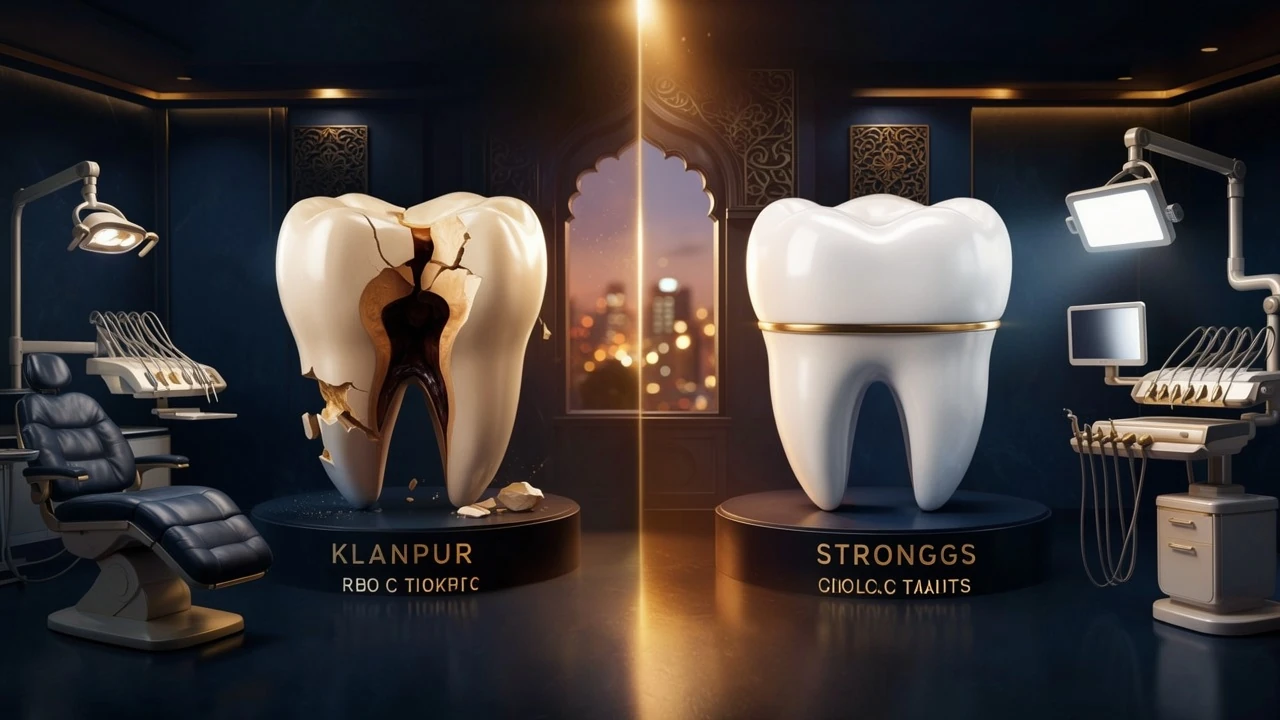
On a rainy Thursday, at a family wedding reception, Rakesh bit into a plate of crispy chaat. There was a sudden sharp crack and an immediate, excruciating pain unlike anything he’d felt during the root canal itself. By Friday morning, clinical examination revealed a vertical root fracture extending from the crown margin to the root apex. The tooth was unsalvageable. His treatment options: extraction followed by a dental implant (₹20,000–₹30,000) or a bridge (₹15,000–₹20,000). A ₹4,000–₹7,000 crown decision had cascaded into a ₹25,000+ dental reconstruction surgery. Rakesh is not an exception. According to systematic reviews in the Journal of Endodontics, endodontically treated posterior teeth without cuspal coverage have a failure rate up to 6 times higher than teeth crowned within 4 months of the root canal procedure.
Failure Risk Timeline: Unprotected vs. Crowned Teeth
2. Why Does a Root-Canal Tooth Become a ‘Hollow Shell’? The 60-Second Science
A root canal procedure removes the pulp — the soft tissue inside your tooth containing nerves, blood vessels, and connective tissue. To access this pulp chamber, your endodontist drills a relatively large access cavity through the biting surface of the tooth. The pulp chamber itself is then cleaned, disinfected, shaped, and filled with gutta-percha.
The result? The tooth loses its internal structure — the dentin that once formed a continuous, pressure-dispersing shell. Here’s the biomechanical problem in plain language:
- ✓ Loss of structural integrity: Removing the pulp and drilling the access cavity reduces the tooth’s resistance to biting forces by at least 40–60% compared to an intact natural tooth.
- ✓ Dehydration & brittleness: Without the pulp’s living fluid supply, dentin in a root-canal tooth gradually dehydrates and becomes 10–20% more brittle over time — like a dry twig instead of a green branch.
- ✓ Wedging forces: When you chew on a hard object, the food acts like a wedge. An intact tooth disperses this force through its crown. A hollow root-canal tooth can’t — the force concentrates on the thin, weakened walls of the access cavity, creating microcracks that propagate into full vertical fractures.
- ✓ Molars bear the brunt: Posterior teeth (molars and premolars) endure chewing forces of up to 70–100 kg during normal eating. They are by far the most common teeth to fracture after root canal without a crown.
This is why virtually every prosthodontist and endodontist treats a dental crown after root canal as a non-negotiable step — not an upsell. The American Association of Endodontists recommends that any root-canal-treated posterior tooth (premolar or molar) receive definitive cuspal coverage (a crown) as soon as possible after the procedure.
3. Your Dental Crown Options in Kanpur: Zirconia / PFM / E-max
Not all crowns are created equal. Depending on which tooth needs protection, your budget, and your aesthetic priorities, an MDS prosthodontist in Kanpur will recommend one of three main types. Here’s the honest comparison:
| Crown Type | Material | Typical Cost in Kanpur | Lifespan | Best For |
|---|---|---|---|---|
| PFM (Porcelain-Fused-to-Metal) | Metal base + ceramic coating | ₹3,000 – ₹5,000 | 10–15 years | Budget-friendly, molars (aesthetics less critical) |
| Zirconia (Monolithic) | High-strength ceramic (zirconium dioxide) | ₹5,000 – ₹9,000 | 15–20+ years | Best value — strength + aesthetics, ideal for molars and premolars |
| E-max (Lithium Disilicate) | Glass-ceramic (layered or pressable) | ₹8,000 – ₹14,000 | 10–15 years | Front teeth — maximum translucency and esthetics |
Material Comparison: Strength vs. Aesthetics vs. Cost
Which Crown Does the Crown Multispeciality Clinic Recommend?
At The Crown Multispeciality Dental Clinic & Implant Center in Kidwai Nagar, our MDS prosthodontist, Dr. Apurva Chaturvedi, typically recommends monolithic zirconia crowns for most posterior root-canal teeth. Why? Because zirconia combines exceptional fracture resistance (approximately 1,200 MPa flexural strength — far exceeding normal biting forces) with metal-free biocompatibility and excellent aesthetics. For front teeth where translucency matters most, E-max is the preference. PFM remains a solid budget choice when cost is the deciding factor — however, its dark metal margin can become visible over time as gums recede.
4. The 5 Scary Consequences of Skipping the Crown
If you’re still tempted to delay the crown, consider these five documented consequences that we see in our clinic far too often:
- 1. Vertical Root Fracture (VRF): This is the killer. An untreated root-canal tooth splits from the chewing surface straight down into the root. Once a VRF reaches the bone level, the tooth is 100% unsalvageable. No retreatment, no post-and-core — only extraction.
- 2. Re-infection (Coronal Leakage): Without a crown, the temporary filling or core material can develop microleakage. Saliva and bacteria seep into the previously cleaned root canals, causing re-infection. If this happens, you face either a retreatment (₹6,000–₹10,000) or an apicoectomy (₹7,000–₹12,000) — on top of still needing a crown.
- 3. Tooth Structure Collapse: A simple cusp fracture on one side may not kill the tooth, but it destabilizes occlusion. Over a year or two, repeated asymmetric loading can cause adjacent teeth to shift, creating bite misalignment and gum pocketing.
- 4. Accelerated Bone Loss and Adjacent Tooth Drift: When a tooth is lost, the jawbone in that area begins to resorb — losing up to 25% of its width within the first year. Adjacent teeth tip into the gap, and the opposing tooth supra-erupts. This complicates future implant placement.
- 5. Emergency Pain and Anxiety: A vertical fracture is extremely painful and requires emergency care. Between clinic visits, root fractures expose nerve endings and can cause intense sensitivity, gum swelling, and even facial swelling that carries its own infection risks.
5. Cost Reality: Today’s ₹3,000 ‘Saving’ vs. Tomorrow’s ₹25,000
Let’s do the Kanpur pricing maths honestly — because no one tells you this when you’re sitting in that dental chair.
Scenario A — You Get the Crown Today
• Root canal: ₹4,000–₹8,000 (inclusive of all sittings)
• Zirconia crown: ₹5,000–₹9,000
• Total investment: ₹9,000–₹17,000
• Result: A protected tooth that functions normally for 15–20 years.
Scenario B — You Skip the Crown and It Fractures in 6–18 Months
• Root canal (already paid): ₹4,000–₹8,000
• Emergency extraction: ₹1,500–₹3,000
• Dental implant + crown: ₹20,000–₹30,000
• OR 3-unit bridge: ₹15,000–₹22,000
• Total rescue cost: ₹21,500–₹41,000
• Result: 2–6 months of treatment, multiple surgical appointments, and permanent hardware where a simple crown would have sufficed.
Cost Comparison: Crown Now vs. Implant/Bridge Later
The key takeaway: For the cost of a mid-range smartphone, you can permanently protect a tooth you already spent time and money saving. The ‘bachat ka jugaad’ (cost-cutting hack) of skipping the crown is arguably the most expensive dental decision a patient in Kanpur can make.
“The cheapest crown is the one you get on time. The most expensive dental treatment is the one you need because you waited.”
— Dr. Apurva Chaturvedi, MDS Maxillofacial Prosthodontist & Implantologist
6. Perfect Timeline: How Soon After Root Canal Should You Get the Crown?
Timing is critical. The longer an endodontically treated tooth goes uncrowned, the higher its risk of fracture. Here’s the ideal timeline recommended by dental specialists:
- Day 0 – Week 1: Complete the root canal and let the periapical tissue settle. The final core build-up should be placed promptly.
- Week 2 – 4 (OPTIMAL WINDOW): Tooth preparation + digital or impression scanning for crown fabrication. The temporary crown is placed. Final crown is usually delivered within 3–7 days with CAD/CAM milling.
- Month 2 – 4: If unavoidable, crown placement within 4 months still significantly reduces fracture risk compared to leaving the tooth uncrowned indefinitely.
- Beyond 4 Months: Risk escalates sharply. Studies show that posterior teeth crowned within 4 months of root canal have 6× lower fracture risk than those left uncrowned beyond that window.
Sunday 11AM–4PM: The Working Professional’s Appointment Hack
For Kanpur’s working professionals who can’t take time off during weekdays, The Crown Multispeciality Dental Clinic & Implant Center offers Sunday appointments from 11AM to 4PM. Whether you’re in Swaroop Nagar, Govind Nagar, Ashok Nagar, Kidwai Nagar, or anywhere across Kanpur, you can complete your crown preparation on a Sunday — no need to skip work or negotiate with your boss for leave. Call +91 8707504822 or book online to reserve your Sunday slot.
Key Takeaways
A dental crown after root canal in Kanpur is not an optional cosmetic add-on — it is essential protective armour. A root-canal-treated tooth loses 40–60% of its structural strength and becomes progressively more brittle without a living pulp. Skipping the crown risks vertical root fracture, re-infection, and eventual extraction followed by a ₹20,000–₹30,000 implant. With PFM crowns starting around ₹3,000 and zirconia at ₹5,000–₹9,000 in Kanpur, the cost-benefit analysis is overwhelmingly in favour of getting the crown on time.
5-Step Action Checklist
- ✓ Book a crown consultation within 4 weeks of your root canal.
- ✓ Ask for a clear price breakdown for PFM, zirconia, and E-max before proceeding.
- ✓ Request an MDS prosthodontist for crown fabrication — material handling and fit precision matter.
- ✓ Confirm whether digital scanning (no messy impressions) and CAD/CAM same-day delivery are available.
- ✓ Schedule your appointment on a Sunday (11AM–4PM) if you work Monday through Saturday.
Ready to Protect the Tooth We Already Saved?
Book your MDS specialist consultation at The Crown Multispeciality Dental Clinic & Implant Center in Govind Nagar, Kanpur. Transparent pricing, zirconia crowns, digital workflow, and Sunday availability.
Book Your Crown ConsultationCall +91 87075 04822 • 133/105 O Block, Site No.1, Kidwai Nagar, Kanpur (Opp. Bandhan Bank)
Related Articles
Tooth Pain When Biting Down in Kanpur: 4 Common Causes
General Dentistry · 9 min read Tooth Hurts When You Bite Down: Four Common Causes Explained by Kanpur…
Cracked Tooth Repair in Kanpur: Save It or Remove It?
Restorative Dentistry · Kidwai Nagar, Kanpur Cracked Tooth Repair in Kanpur: How a Dentist Decides Between Saving a…
How Do Braces Work in Kanpur? The Biology of Tooth Movement
Orthodontics • 14 min read How Do Braces Work in Kanpur? The biology behind tooth movement — what…